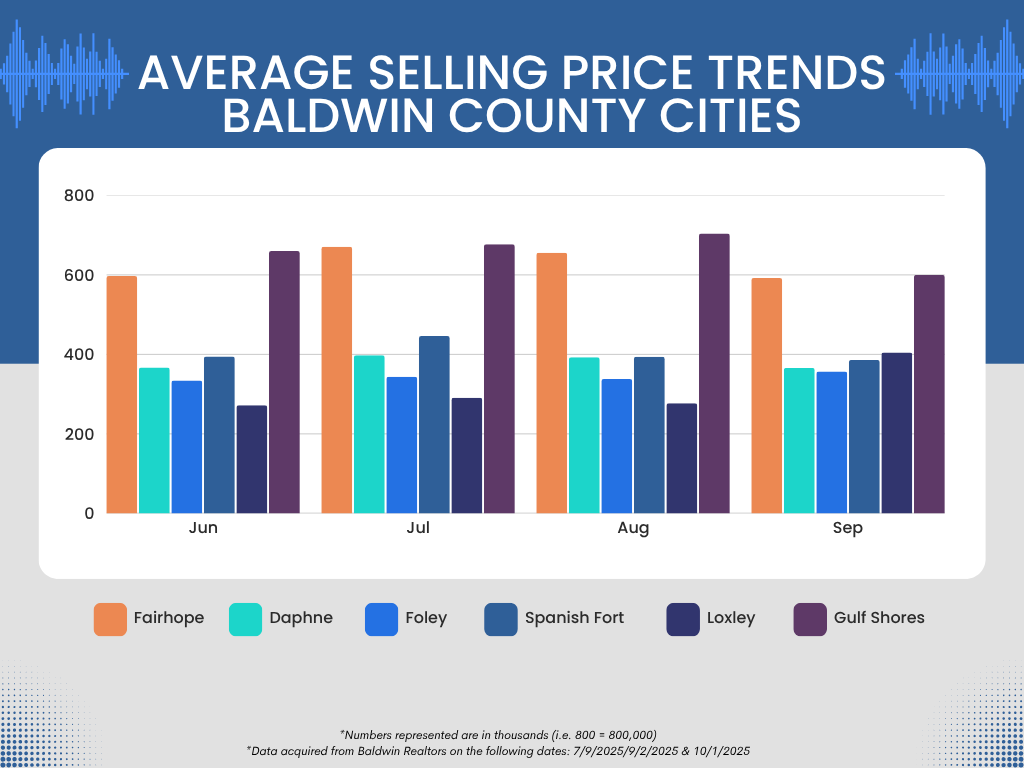
If you are trying to identify Baldwin County’s next wave of growth, there is no single winner. Foley offers a strong near-term combination of services, housing and coastal access. Loxley presents the most intriguing growth opportunities.Robertsdale remains an important Central Baldwin workforce and service market. Daphne offers the most established combination of amenities, Mobile access and resale activity.
“Where is Baldwin County growing next?” is not quite the right question.
The better question is: Which kind of growth best fits the way you want to live, own, sell or manage property?
That distinction matters in a county whose estimated population reached 267,761 in 2025—up 15.5% from the 2020 estimate base. Baldwin County also recorded the fastest year-over-year employment growth among Alabama’s largest counties through December 2025.[2][3]
Growth is real. It simply is not landing evenly in every city, subdivision or price range.
What the latest Baldwin County listing and rent numbers show
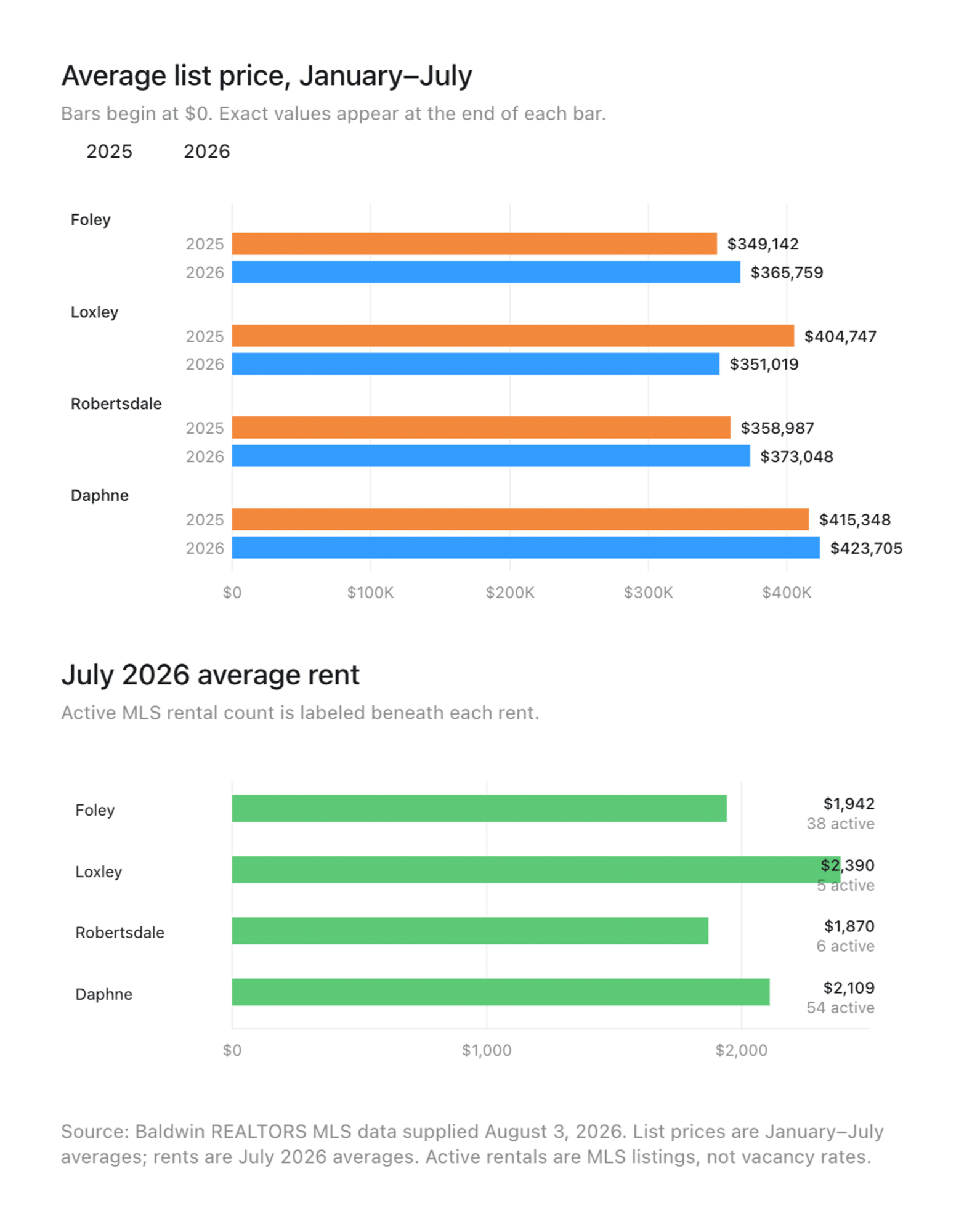
The purchase figures are average list prices from January through July, not closed-sale prices or estimates of appreciation. The rental figures are average rents as of July 2026, accompanied by the number of active rental listings in the MLS.
 These numbers are more current and locally specific than national listing-platform data, but they still need to be interpreted carefully.
An increase in average list price does not prove that an individual home appreciated by the same percentage. A decline does not necessarily mean property values fell by that amount. Changes in the size, age, condition and location of homes listed can move an average significantly.
The rental figures also represent current market evidence—not guaranteed achievable rents. That is especially important in Loxley and Robertsdale, where only five and six active rentals were represented.
This data came directly from Baldwin REALTORS Multiple Listing Service on August 3, 2026.[1]
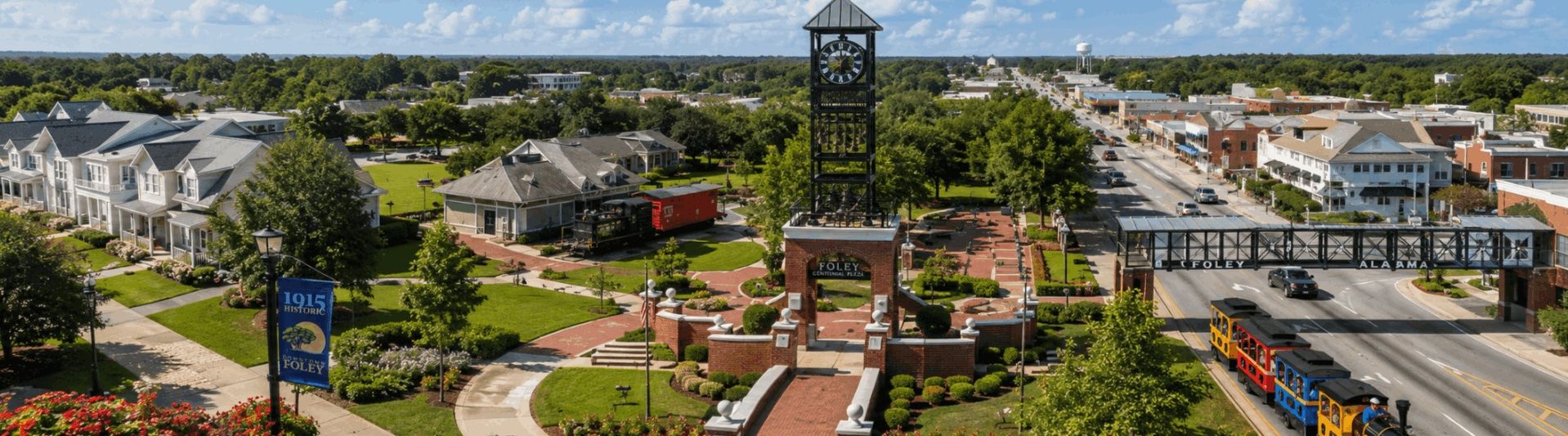
Foley: The strongest near-term all-around growth market
Foley increasingly functions as the year-round service and residential center behind the beach economy.
Its location supports access to retail, healthcare, hospitality, construction, tourism-related employment and the coastal communities. Residents can reach Gulf Shores and Orange Beach without assuming the full acquisition price and carrying costs that often accompany coastal property.
The $15 million terminal expansion underway at Gulf Shores International Airport also strengthens South Baldwin’s transportation network. The airport reported more than 34,000 passengers in June 2026, and the expanded terminal was expected to open before summer 2027.[5]
More air service does not guarantee higher property values. It can, however, support tourism employment, corporate travel, second-home activity and businesses serving South Baldwin.
For buyers, Foley offers:
- A substantial selection of existing homes and new construction
- Convenient shopping, medical care, restaurants and daily services
- Access to coastal employment without living directly on the beach
- A wider range of housing choices than many smaller Baldwin County communities
For rental owners, potential tenant groups may include healthcare workers, hospitality managers, construction employees, local families, retirees in transition and households that want proximity to the beach without beach pricing.
Supply is the caution. New construction and builder incentives can make resale homes compete directly with new houses offering warranties or closing-cost assistance.
Rental owners should also distinguish year-round tenant demand from seasonal tourism activity. The two are connected, but they are not interchangeable.
Best fit: Buyers and owners who want a growing service center with access to the coast.
Watch carefully: New construction supply, insurance costs, Alabama 59 traffic and resale competition from builders.
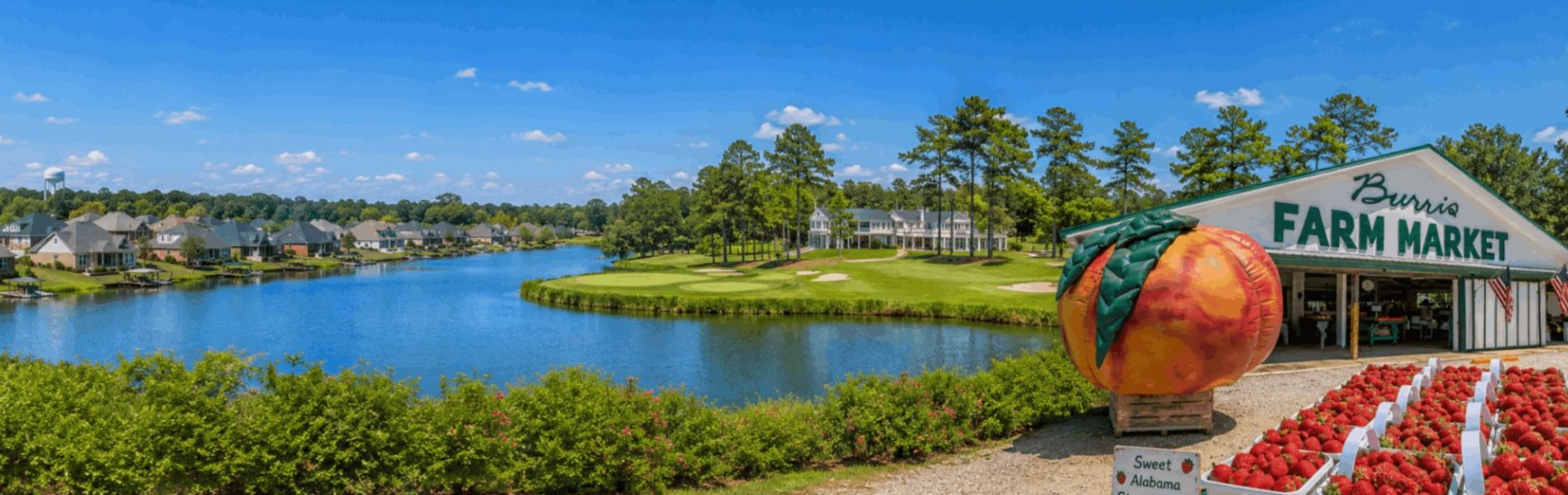
Loxley: The most intriguing—and least proven—rental signal
Loxley’s principal advantage is its position near Interstate 10 and the routes connecting the Eastern Shore, Mobile, Central Baldwin and South Baldwin. That location can appeal to commuters, logistics employees, service businesses and households trying to remain within reach of several employment centers.
Loxley, Alabama’s growth story is also becoming increasingly industrial.
In July 2026, Terravanta Power Systems—a subsidiary of Kaishan Compressor USA—broke ground on a planned $74.5 million, 200,000-square-foot geothermal-equipment manufacturing and assembly facility expected to create 63 jobs.[10] This follows Buffalo Rock’s new $10 million Loxley distribution facility, associated with approximately 100 relocated jobs, and Butting USA’s addition of 100 stainless-steel-processing jobs.[11][12] These projects strengthen Loxley’s employment base and support its emerging role as an industrial and logistics center.
Loxley had the lowest 2026 average list price in this four-market comparison at $351,019. That was down from $404,747 during January–July 2025, a decrease of approximately 13.27%.[1]
However, this should not be described as a 13.27% decline in home values without reviewing closed sales and the mix of properties listed. Loxley is a small housing market and the average is frequently skewed. when fewer luxury homes in Steelwood are available, more new entry-level inventory and differences in acreage and property types regularly move the average.
Loxley also recorded the highest average rent at $2,390.[1] At first glance, the combination of the lowest average list price and highest average rent looks compelling.
The challenge here is also sample size: only five active MLS rentals supported that average.
A few large, furnished, newer or unusually positioned properties could materially raise the number. The $2,390 figure is therefore a signal worth investigating, not a market-wide rent assumption suitable for underwriting every Loxley property.
For buyers, Loxley may offer newer subdivisions, interstate access and opportunities to obtain more space than in established Eastern Shore neighborhoods.
For landlords, possible tenant groups include commuters, logistics and distribution employees, families seeking newer housing and households priced out of higher-cost Eastern Shore locations. These are market interpretations rather than reported demographic counts.
Newer construction may provide more predictable near-term maintenance, but it can also create leasing competition when several similar homes become available simultaneously.
Best fit: Buyers and rental owners who value regional access and want exposure to a growing employment, manufacturing and logistics corridor—while recognizing that the current rental sample remains very small.
Watch carefully: The small rental sample, subdivision delivery, utility capacity, builder incentives and competing new homes.
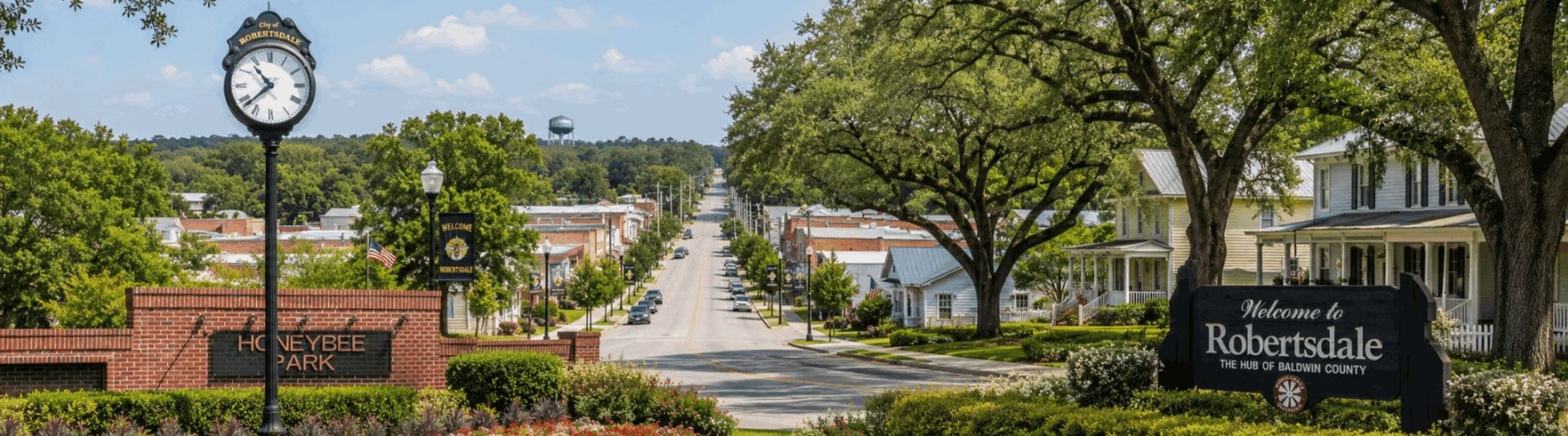
Robertsdale: A workforce and service-market opportunity
Robertsdale serves as an administrative, service and transportation center in Central Baldwin.
Robertsdale is not the lowest-priced market in this updated comparison; Loxley holds that position based on 2026 average list prices. Robertsdale’s appeal is better described as practical Central Baldwin access and potential workforce-housing demand—not simply the cheapest purchase price.
The average July rent was $1,870, based on six active MLS listings.[1] That is the lowest average rent among the four markets, and the small sample means owners should be conservative when estimating achievable rent.
Baldwin County’s wage data helps explain why attainable housing remains important. The county’s average weekly wage reached $1,084 in the fourth quarter of 2025, up 4% from a year earlier. Alabama’s average was $1,301, while the national average was $1,569.[3]
Those wage figures do not establish demand for any particular property, but they illustrate the continuing pressure to provide housing aligned with local incomes.
County Road 65 is also worth monitoring. Baldwin County advertised work to grade, drain, base and pave County Road 65 from County Road 28 to County Road 32 in 2026.[6] Its effect on nearby property demand will depend on completion, future transportation phases and surrounding development, so it should be treated as a long-term watch item—not an immediate value guarantee.
For rental owners, Robertsdale’s potential strength is practical housing serving households seeking a Central Baldwin location. Because rents are more moderate, operating discipline matters. Deferred maintenance, prolonged vacancy, frequent turnover or an oversized renovation budget can consume a substantial portion of the property’s income.
Best fit: Buyers and owners interested in Central Baldwin access and practical workforce or family housing.
Watch carefully: Property-specific rent ceilings, the limited active rental sample, maintenance needs, utility availability and competition from new construction.
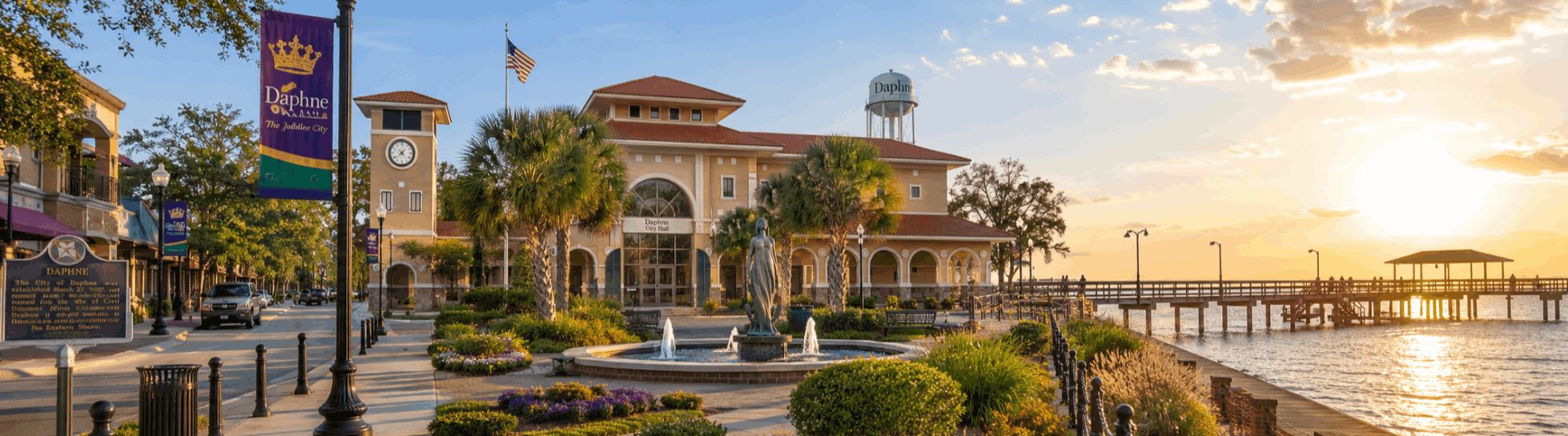
Daphne: The established Eastern Shore choice
Daphne is the most established housing market in this four-city comparison.
It combines Eastern Shore amenities, access to Mobile employment, medical services, shopping, restaurants, established neighborhoods and proximity to Interstate 10.
Daphne’s average July rent was $2,109, based on 54 active MLS rental listings.[1] This was the largest rental sample in the four-city comparison and should provide a broader picture of advertised rental conditions than the five listings in Loxley or six in Robertsdale.
However, the larger rental supply also means Daphne tenants may have more choices. Owners need to compete on condition, price, location, pet policies and responsiveness.
Daphne’s higher acquisition costs can leave less room for insurance, taxes, repairs, vacancy and professional management. A higher rent does not necessarily produce a better return when the purchase price and expenses are also higher.
Transportation remains part of the calculation. Daphne’s Milton Jones Road extension project included a roundabout at County Road 13 and Milton Jones Road, an extension toward Friendship Road and related drainage improvements. A 2026 city update said the broader project would connect Pollard Road to Highway 181, adding another east-west corridor.[7][8]
Buyers should still test their commute during school traffic, I-10 bridge congestion and summer travel.
Best fit: Buyers prioritizing established amenities, Mobile access and broad resale appeal.
Watch carefully: Purchase-price-to-rent relationships, rental competition, traffic, insurance, taxes and new construction on Daphne’s edges.
What about schools and commute times?
Both should be evaluated at the property level.
School attendance zones, transportation arrangements, program availability and capacity can change. Buyers should verify current information directly with Baldwin County Public Schools rather than relying on an old listing description or informal neighborhood advice.
The same applies to commute times. A property may look close to work on a map but perform differently during bridge congestion, Alabama 59 beach traffic, school drop-off, seasonal events or storm evacuation activity.
A test drive at the time someone would normally commute is more useful than a generic drive-time estimate.
The property-management view: What the MLS data does—and does not—tell us
The July 2026 rental data produces three important conclusions.
First, Daphne has the deepest active rental sample in this comparison, with 54 listings. That provides more evidence for its $2,109 average rent, but it also indicates more direct competition for tenants.[1]
Second, Foley presents a meaningful middle ground, with an average rent of $1,942 supported by 38 active listings.[1]
Third, Loxley and Robertsdale require extra caution. Their rent averages were based on only five and six active listings. Those figures may be directionally useful, but they should not be treated as verified achievable rents for a typical three-bedroom home. This is where a Baldwin County expert in rental management can provide valuable input based on years of knowledge.
Active rental listings are also not the same as vacancy rates. The MLS data does not show every privately managed rental, apartment community, lease renewal or off-market property.
A credible rental evaluation should include:
- Recently leased comparable properties
- Competing active rentals
- Days on market
- Bedroom and bathroom count
- Square footage and age
- Neighborhood and school zoning
- Pet policies
- Included utilities or services
- Property condition and finishes
- Insurance, taxes and maintenance costs
- Expected vacancy and turnover
Insurance deserves attention in all four markets. Wind exposure, roof age, flood designation, deductibles and construction features can materially affect ownership costs. Baldwin County maintains an official flood-zone information resource, but buyers should also obtain property-specific flood determinations and insurance quotes before purchasing.[9]
So, which market is Baldwin County’s next growth winner?
Based on the August 3, 2026 MLS data and the wider Baldwin County August Growth Watch:
Foley has the strongest near-term combination of housing, services, tourism support and airport-related momentum. Its rental sample is large enough to offer useful market context.
Loxley has the lowest 2026 average list price and highest July average rent in the comparison, but its five active rentals make that apparent advantage preliminary rather than conclusive.
Robertsdale remains an important Central Baldwin workforce and service market, although the updated data no longer supports describing it as the lowest-priced option.
Daphne offers the most established combination of amenities, Mobile access and Eastern Shore resale activity. Its 54 active rentals provide the strongest rental sample, but also the greatest visible rental competition.
These are evidence-based market interpretations, not predictions of appreciation, occupancy or investment returns.
The winner is not necessarily the city growing fastest or displaying the highest average rent. It is the property whose location, price, condition, insurance costs, likely tenant or buyer and resale strategy still make sense after the growth story has been removed from the sales pitch.
Ashurst Niemeyer Real Estate Advisors can help buyers and sellers compare neighborhoods, new construction, resale competition and long-term marketability across Baldwin County. For rental owners, Level Property Management Group can provide property-specific rent analysis, maintenance planning, leasing guidance and an assessment of whether the numbers work in the real world.
Because in a growing county, choosing the right market matters. Choosing the right property within that market matters even more.
Sources and Data References
[1] Baldwin REALTORS Multiple Listing Service.
MLS data provided August 3, 2026. Average list prices compare January–July 2026 with January–July 2025. Rental figures represent average rents as of July 2026, with active MLS rental counts reported on August 3, 2026. MLS data is proprietary and may change as listings are added, withdrawn, leased or corrected.
[2] U.S. Census Bureau — QuickFacts: Baldwin County, Alabama.
Population estimate of 267,761 as of July 1, 2025; 15.5% estimated population growth from the April 2020 estimate base through July 2025.
View the Census Bureau data
[3] U.S. Bureau of Labor Statistics — County Employment and Wages in Alabama, Fourth Quarter 2025.
Published June 9, 2026. Baldwin County covered employment: 87,796; annual employment growth: 2.5%; average weekly wage: $1,084; annual wage growth: 4%.
View the BLS report
[4] Baldwin REALTORS — Baldwin County’s June 2026 Housing Report.
Published through the Eastern Shore Chamber of Commerce on July 10, 2026. Used for Eastern Shore and Central Baldwin closed-sale statistics.
View the June housing report
[5] City of Gulf Shores — Gulf Shores Airport Breaks Ground on $15 Million Terminal Expansion.
Published July 21, 2026.
View the airport announcement
[6] Baldwin County Commission — County Road 65 Project HW22030.
Official project title: “Grade, Drain, Base & Pave CR 65 from CR 28 to CR 32.”
View the County Road 65 bid
[7] City of Daphne — Milton Jones Road Extension Bid.
View the project description
[8] City of Daphne — County Road 13 at Milton Jones Road Extension Project Update.
Published April 23, 2026.
View the project update
[9] Baldwin County Building Inspection Department — Flood Zone Information.
View Baldwin County flood information
Updated August 3, 2026. The real estate figures are market averages for the reporting periods shown and should not be applied to an individual property without a current comparative market or rental analysis.